
Crafted in Europe, Shipped Worldwide
The Profound Mystery of the Crucifixion Icon: Hand-Painted Orthodox Traditions

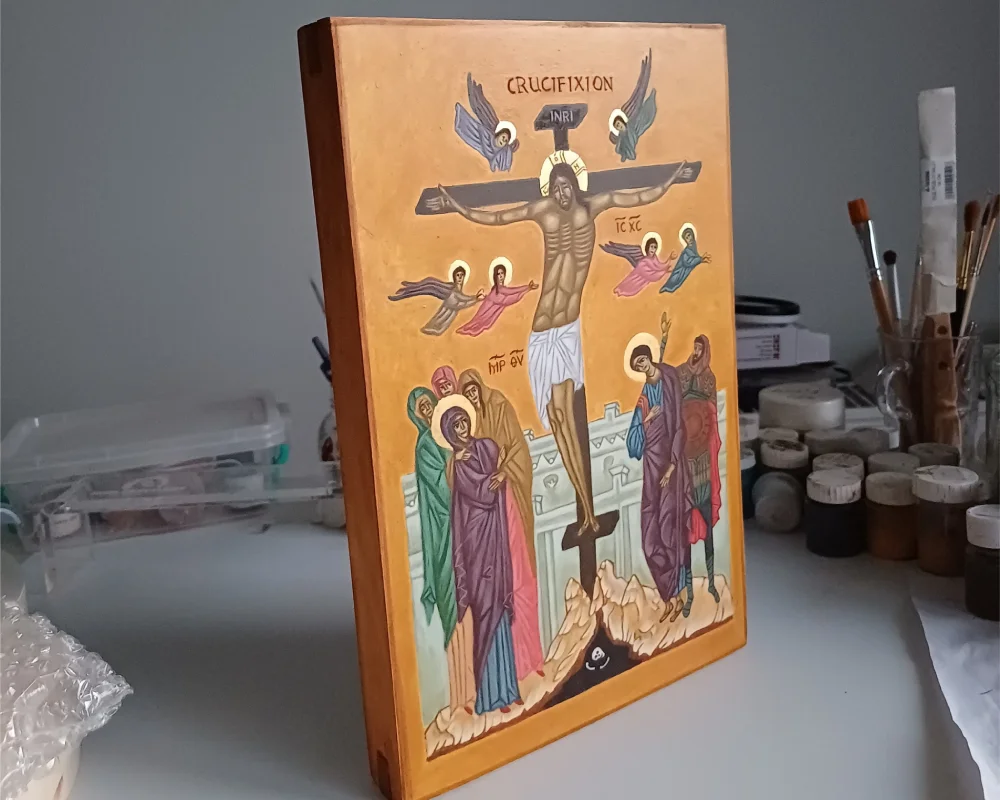
In the realm of sacred art, the Crucifixion Icon is not merely a depiction of a historical event; it is the theological heartbeat of the Christian faith. For centuries, believers have used the Passion of Jesus icon as a “window into heaven,” a medium through which the divine sacrifice on Golgotha becomes a present reality. At Iconoria Studio, I completed a hand-painted Crucifixion icon, crafted with the ancient egg tempera technique on a rectangular wooden board, designed to bring the profound peace of Christ into your home.
Whether you are looking to enrich your home altar or starting a prayer corner, understanding the rich history and intricate symbolism of this icon is essential. It remains the most significant image in the world of iconography, representing the bridge between human suffering and divine redemption.
The History of the Crucifixion in Art: From Renaissance to Baroque
While Orthodox iconography follows strict, unchangeable canons, the scene of the Crucifixion has evolved significantly through Western art history. Understanding these shifts helps us appreciate the timelessness of the traditional icon.
Renaissance and Baroque Influences
During the Renaissance, masters like Giotto and Masaccio began to move away from symbolic representations, focusing instead on human anatomy and the physical weight of Christ’s body. They sought to evoke empathy through realism. Later, in the Baroque period, artists such as Caravaggio and Rubens used dramatic lighting and intense emotion to highlight the “Man of Sorrows.”
However, while Western art often focuses on the agony of the death, a traditional Crucifixion icon focuses on the victory over death. Even on the cross, Christ is portrayed with a sense of royal dignity and divine calm. This unique perspective is what makes the icon a powerful tool for meditation. For a broader look at the historical impact of these styles in the United States, the National Gallery of Art provides an excellent digital archive of religious masterpieces.
The Shape of Sacredness: Rectangular Boards and Cross-Shaped Icons
In the world of iconography, the support—the wooden board—is as symbolic as the paint itself.
The Traditional Rectangular Icon
My work is a Crucifixion icon painted on a beautiful, elongated rectangular wooden board. This format allows for a comprehensive narrative, including the landscape of Jerusalem and the celestial bodies above. In many Orthodox churches, these rectangular icons are placed prominently on the iconostasis or side altars to guide the faithful through the liturgical year.
Icons in the Shape of a Cross
Historically, iconography also produced icons carved in the shape of the Cross itself. These are frequently found suspended over the main altar in cathedrals or placed atop the iconostasis. A famous example is the San Damiano Cross, the very icon before which St. Francis of Assisi prayed when he received his divine calling. While my Crucifixion work is on a rectangular board, the influence of the San Damiano style—where the cross itself tells a story—is a constant inspiration. You can learn more about this in my blog post about St. Francis and the power of prayer.
The Sacred Symbols of Golgotha: Angels, Blood, and the Centurion
When you look closely at a Crucifixion icon, you notice a world of detail that standard paintings often omit. Each element is designed to lead the viewer into a deeper state of prayer.
The Chalice of Life
In many traditional icons, you will see Angels hovering near the wounded hands and side of Christ. They are not merely observers; they hold sacred vessels to collect the blood and water flowing from His side after being pierced by the soldier’s lance. This represents the Sacrament of the Eucharist—reminding us that the sacrifice on the cross is the same sacrifice we participate in during the Liturgy.
The Witnesses at the Cross
To the left of the Cross stands the Virgin Mary, the Theotokos, alongside Mary Magdalene and other holy women. To the right stands St. John the Beloved, the only apostle who remained faithful until the end. Often, the Roman centurion Longinus is also depicted, representing the conversion of the Gentiles.
In the broader history of Christian art, it is common to find monumental compositions featuring three crosses—Jesus in the center, flanked by the two thieves. This historical representation serves as a powerful theological reminder of human free will: the ‘Penitent Thief’ who chose mercy and the ‘Impenitent Thief’ who did not.
My Artistic Process: Egg Tempera and Gold Leaf
Creating a hand-painted icon is a slow, liturgical process. For my Crucifixion piece, I used:
- Natural Wood: A solid, elongated rectangular board, prepared with traditional gesso.
- Egg Tempera: An ancient medium where natural earth pigments are mixed with egg yolk, ensuring the icon will last for centuries without losing its vibrancy.
- 24K Gold Leaf: Applied to the halos of Christ, the Angels, and the Saints. The gold represents the “Uncreated Light” of the Kingdom of God.
Every stroke is a prayer, intended to create a piece that isn’t just art, but a spiritual companion. If you are interested in other depictions of Christ, you might explore the Mandylion (Image Not Made by Hands) or my full collection of Hand-painted Jesus Icons.
Beyond the Cross: The Epitaphios and Passion Icons
The story of the Passion does not end at the Cross. Another deeply moving piece in my studio is the Epitaphios icon, which depicts Jesus in the Tomb. This icon shows the body of Christ after the descent from the cross, lying in the tomb before the Resurrection.
While the Crucifixion icon represents the act of sacrifice, the Epitaphios represents the “Blessed Sabbath,” the silence and hope that precedes the miracle of Pascha. Together, they form a complete cycle of devotion for your home altar.
Why a Crucifixion Icon is Essential for Your Home
Adding a Crucifixion icon to your domestic church is a transformative act. It is widely considered the most important of all icons because it depicts the moment of our salvation.
- A Center for Prayer: It serves as a visual reminder of God’s infinite love, helping to focus the mind during times of distress or gratitude.
- Spiritual Peace: As I discussed in my post on how icons mobilize prayer and bring peace, surrounding ourselves with sacred imagery helps shield our homes from the chaos of the modern world.
- A Legacy Piece: These icons are heirloom-quality, designed to be passed down through generations as a testament of faith.
Bring the Light of Iconoria Studio into Your Home
At Iconoria Studio, I am committed to sharing the beauty of Orthodox iconography with the world. I understand that purchasing a hand-painted icon is a significant decision, which is why I ensure the process is as seamless as possible.
- Worldwide Shipping: I ship my icons from my studio directly to your door, whether you are in the heart of New York, the hills of California, or anywhere across the globe.
- Free Shipping: To celebrate the spread of sacred art, I offer completely free shipping on all orders.
- Ready for Devotion: Each icon is crafted with the highest quality materials, ready to be placed in your prayer corner or on a home altar.
Final Thoughts
The Crucifixion icon is the ultimate symbol of victory. By choosing a hand-painted icon created with traditional egg tempera and gold leaf, you are not just buying a product—you are welcoming a sacred tradition into your life.
Explore my Collection of Jesus Icons today and find the piece that speaks to your soul.