
Crafted in Europe, Shipped Worldwide
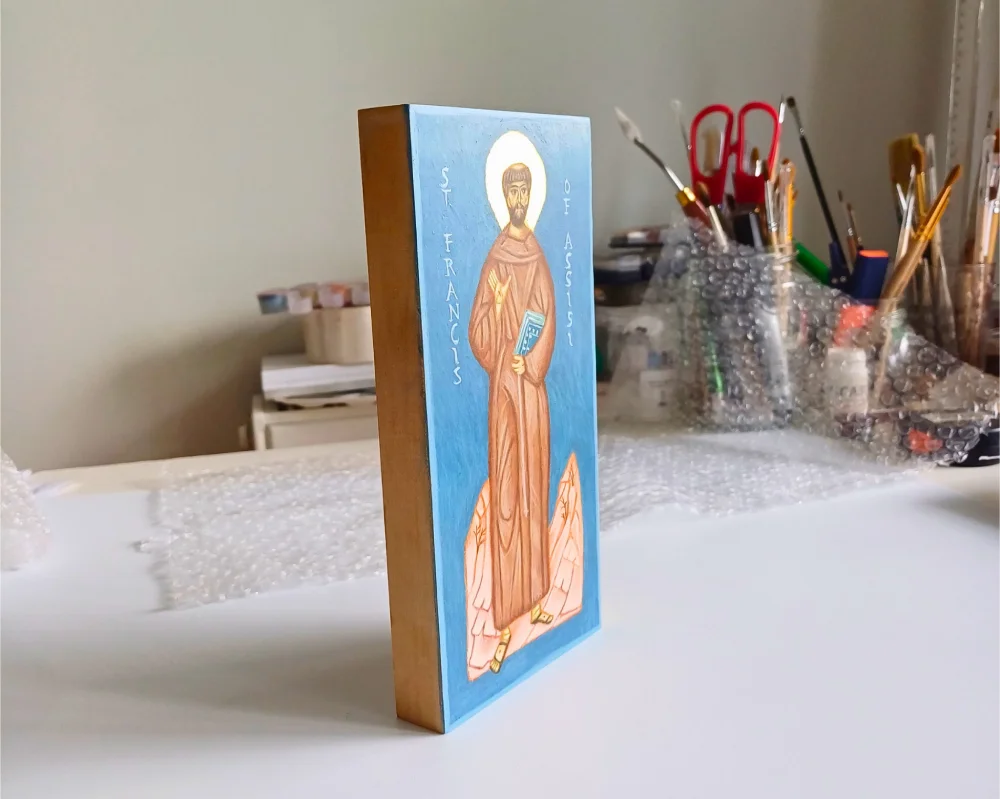
Bring Peace Home with a Hand-Painted St. Francis of Assisi Icon on Wood

When you hold a hand-painted St. Francis of Assisi icon on wood, you aren’t just holding a piece of religious art; you are holding a window into the 13th century. Created using the ancient technique of traditional egg tempera religious art on a solid wood panel, these icons carry a weight of history and devotion that mass-produced prints simply cannot replicate.
In the world of Byzantine and Western iconography, Saint Francis remains one of the most beloved figures. His life, marked by radical poverty and an overwhelming love for creation, continues to inspire millions. For those looking to deepen their prayer life, bringing a Byzantine style Francis of Assisi wood panel into the home offers a daily reminder of humility and peace.
The Early Life of Giovanni di Pietro di Bernardone
Before he was the “Poverello” (the little poor man), he was born in 1181 or 1182 as Giovanni di Pietro di Bernardone. His father, a wealthy silk merchant, renamed him “Francesco” (the Frenchman) due to his infatuation with France.
Young Francis lived a life of luxury and chivalry until a series of spiritual encounters changed him forever. The turning point occurred in 1205 at the crumbling Church of San Damiano. While praying before a Byzantine crucifix, Francis heard the voice of Jesus Christ speaking from the cross, saying: “Francis, go and repair My house which, as you see, is all moving forward to ruin.”
Initially, Francis took this literally, selling his father’s cloth to fix the physical building. However, he soon realized his mission was to rebuild the spiritual foundation of the entire Church. This pivotal moment is why many collectors seek out a Crucifixion Icon to place alongside their images of St. Francis.
Symbolism of the Hand-painted St. Francis of Assisi Icon on wood : The Habit and Three Knots
When you look at a hand-painted Saint Francis of Assisi icon on wood, every detail is intentional. My icons utilize genuine gold leaf to represent the uncreated light of God, creating a shimmering halo that draws the viewer into a state of contemplation.
The Significance of the Franciscan Habit
In iconography, Saint Francis is almost always depicted wearing a coarse brown habit. This was the dress of the poorest peasants in medieval Italy. Around his waist is a simple cord with three knots. These knots are vital facts of Franciscan symbolism, representing the three evangelical counsels:
- Poverty
- Chastity
- Obedience (often associated with deep humility)
The Stigmata: Sharing in the Passion
Perhaps the most profound element of Francis’s life occurred in 1224 on Mount La Verna. It was here that he became the first recorded person in history to receive the stigmata—the physical wounds of Christ’s crucifixion. In a high-quality Saint Francis of Assisi stigmata iconography piece, you will see small, delicate marks on his hands and side, symbolizing his total union with the suffering of Jesus.
“It is in giving that we receive; it is in pardoning that we are pardoned.” — The Peace Prayer of Saint Francis
Patron Saint of Animals, Ecology, and Peace
It is impossible to discuss St. Francis without mentioning his connection to nature. He viewed all living things as his brothers and sisters. Famous stories detail him preaching to birds who stayed still to listen, or negotiating peace with the “vicious” wolf of Gubbio that had been terrorizing a local town.
Because of this, he was named the patron saint of ecology and animals. Having a Saint Icons collection in your home, specifically featuring Francis, serves as a beautiful reminder of our responsibility to care for the Earth.
The Assisi Connection: From the Monastery to the Basilica
Assisi, Italy, remains the heart of the Franciscan movement. The Basilica of Saint Francis, a UNESCO World Heritage site, houses the remains of the saint and stunning frescoes by Giotto. This monastery complex (the Sacro Convento) is a testament to how art has always been used to tell the story of faith.
For more historical context on the architecture and preservation of Franciscan sites, you can visit the Official Site of the Basilica of Saint Francis.
The Evolution of the Franciscan Order: A History of Radical Gospel Living
The history of the Franciscan Order, formally known as the Order of Friars Minor (Ordo Fratrum Minorum), began in 1209 when Pope Innocent III gave oral approval to Francis’s simple “Rule of Life.” Unlike the monks of the early Middle Ages who remained cloistered within a single monastery, the Franciscans were mendicants—itinerant preachers who owned nothing and lived among the people. This movement grew with astonishing speed; within just a few decades, thousands of brothers had joined the mission, spreading from the small Italian village of Rivotorto to the furthest corners of Europe and the Holy Land.
Saint Clare and the Poor Clares
Francis’s mission was not a solitary one. Saint Clare of Assisi, inspired by Francis’s preaching, founded the Order of Poor Ladies (now the Poor Clares). Her life of “holy privilege” (the privilege of owning nothing) mirrored Francis’s own path. Their spiritual friendship is a cornerstone of Church history, proving that the path to God is often shared with kindred souls.
A Modern Connection: Saint Francis and Blessed Carlo Acutis
Interestingly, Saint Francis was the favorite saint of a modern-day hero: Saint Carlo Acutis. Carlo, the first “millennial saint,” felt a deep pull toward Assisi and requested to be buried there. He saw in Francis a mirror of the Eucharistic love he felt for Jesus.
Just as Carlo used technology to spread the Gospel, I use the ancient medium of egg tempera to bring these timeless truths into modern homes. If you are starting your spiritual journey, you might wonder Why every home needs an icon of Jesus, as it provides the Christ-centered foundation that Francis himself lived by.
Why Choose a Custom Wood Panel Icon with Gold Leaf?
Our icons are not mass-produced in a factory. They are the result of hours of prayerful labor.
- Egg Tempera: I use natural pigments mixed with egg yolk, a method that ensures the colors remain vibrant for centuries.
- Wood Panels: Every Byzantine style Francis of Assisi wood panel is seasoned to prevent warping.
- Gold Leaf: 23k or 24k gold leaf is applied by hand, reflecting light in a way that creates a “living” image during evening prayer or candlelight.
If you are looking for a specific size or a particular scene from the saint’s life, I offer Custom Catholic icons with gold leaf tailored to your devotional needs.
How to Pray with Your Saint Francis Icon
Icons are often called “theology in color.” To pray with your hand-painted Saint Francis of Assisi icon on wood, place it in a quiet “prayer corner.” Light a candle to catch the gold leaf and recite the Canticle of the Sun or the Prayer Before the Crucifix.
Focus on the eyes of the saint. In iconography, the eyes are often slightly enlarged to represent spiritual wakefulness. Let the image of Francis guide you toward the image of Christ. For those specifically devoted to the Lord, I recommend browsing my Jesus Icons to find a central piece for your home altar.
Bring the Peace of Assisi Into Your Home
Are you ready to own a piece of sacred history? My hand-painted Saint Francis of Assisi icons are more than just decor; they are heirlooms of faith. Whether you are buying a gift for a Confirmation, a wedding, or for your own personal devotion, a handmade icon carries a soul that machines cannot replicate.
Click here to view my currently available Saint Francis of Assisi Icons for sale .Limited pieces are available due to the time-intensive nature of the egg tempera process.