
Crafted in Europe, Shipped Worldwide
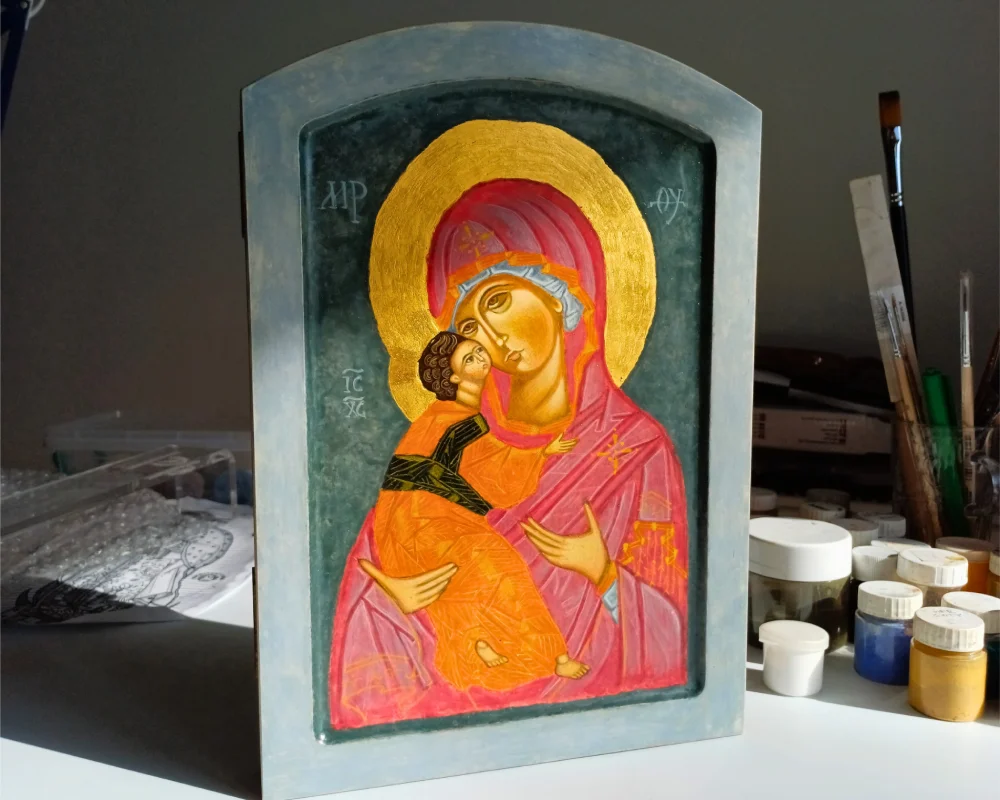
The Eternal Grace of the Our Lady of Vladimir Icon: A Spiritual Masterpiece for Your Home

The Our Lady of Vladimir icon is not merely a piece of religious art; it is a profound “window into heaven.” Known as one of the most venerated images in Christendom, this depiction of the Virgin Mary has protected nations, inspired saints, and defined the aesthetic of Eastern Orthodox iconography for centuries.
If you are looking to bring this sacred presence into your home, understanding its deep historical roots and the meticulous process of its creation is essential. At Iconoria, I specialize in creating faithful, hand-painted recreations of this Theotokos masterpiece, ensuring that every brushstroke honors the 12th-century Byzantine original.
The History and Origin of the Vladimir Mother of God
The original Vladimir Mother of God is a 12th-century Byzantine masterpiece sent from Constantinople to Kiev around 1131. It is widely considered the most important religious painting in history, often referred to as the “Protector of Russia.”
The Legend of St. Luke the Evangelist
According to pious tradition, the original image was painted by St. Luke the Evangelist on a wooden board taken from the table used by the Holy Family in Nazareth. While art historians date the surviving panel to the Byzantine era, this legend underscores the icon’s role as a direct link to the life of Christ.
Survival and Restoration by Andrei Rublev
Throughout history, the icon survived numerous fires, pillages, and wars. Because of these calamities, only small portions of the original 12th-century paint remain (primarily the faces). Over the centuries, the icon was restored by several masters, including the legendary Andrei Rublev, whose influence helped preserve its ethereal beauty for future generations.
Iconographic Symbolism: The Eleusa Type
The Our Lady of Vladimir is the definitive example of the Eleusa (Tenderness) type of iconography. Unlike more formal, “majestic” depictions of the Virgin Mary, the Eleusa style emphasizes the intimate, maternal bond between Mother and Child.
The Composition of Divine Love
In this icon, the Christ Child is shown nestled in the arms of His mother, pressing His cheek against hers. This “cheek-to-cheek” posture is the hallmark of the Eleusa style, symbolizing the ultimate union of the human and the divine.
- The Gaze of the Theotokos: While the Christ Child gazes directly into the eyes of His mother, the Virgin Mary looks out toward the viewer. Her expression is one of “luminous sorrow”—she perceives the future suffering of her Son, inviting the viewer into a space of empathy and prayer.
- The Inscriptions: The original work bears the Greek abbreviation MP ΘΥ (Meter Theou – Mother of God), confirming her status as the Theotokos.
- Byzantine Features: The style is distinctly Byzantine, featuring an elongated nose, small lips, and large, soulful eyes that seem to follow the viewer across the room.
The Sacred Craft: How I Paint the Vladimir Icon at Iconoria
Creating a holy icon is a liturgical act. At Iconoria, I follow the ancient “Prosapion” technique to ensure that each piece is a worthy successor to the work of the old masters.
The Selection of Linden Wood (Linden Board)
Every icon begins with the wood. I use high-quality linden wood (basswood), which is traditionally favored for its stability and fine grain. The board features a kovcheg (a recessed “ark” or “cradle”), which symbolizes the sacred space where the divine image resides, separated from the physical world.
Egg Tempera and Olive Sankir
Following the Byzantine tradition, I use egg tempera—a mixture of natural dry pigments and egg yolk.
- The Sankir: For the flesh tones, I apply an “olive sankir” (a dark greenish-brown base layer).
- The Highlights: Slowly, layers of lighter colors are built up to reveal the faces, symbolizing the light of Christ emerging from the darkness.
The Radiance of 24K Gold Leaf
The halo surrounding the head of the Theotokos and the Christ Child is gilded with genuine 24K gold leaf. In iconography, gold represents the uncreated light of God. When you light a candle in front of an Iconoria piece, the gold leaf catches the flame, creating a living, breathing glow that aids in meditation.
Why Choose a Hand-Painted Icon from Iconoria?
In a world of mass-produced prints, a hand-painted icon on wood carries a unique spiritual energy.
- A Faithful Copy of Andrei Rublev’s Vision: My icons are inspired by the restorations of Rublev, capturing the softness and spiritual depth that defines his style.
- Archival Quality: By using linden wood and egg tempera, these icons are built to last for centuries, becoming family heirlooms.
- Direct from the Artist: You are not buying from a warehouse. Each icon is a fruit of my prayer and labor, painted with the same devotion as the monks of old.
Bring the “Protector of Nations” into your prayer corner today. View my current Our Lady of Vladimir Icon for sale or browse our full Virgin Mary Icons collection.
A Spiritual Treasure and a Meaningful Prayer Companion The Our Lady of Vladimir icon is more than art; it is a powerful aid in daily prayer. For centuries, believers have turned to this image to seek the protection of the Vladimir Mother of God, reciting prayers for peace, family unity, and guidance. Placing this icon in your home creates a sacred space where the “luminous sorrow” of the Theotokos offers comfort and a deep connection to the divine presence.
The Icon Today: From Tolmachi to Your Home
While the original 12th-century icon is currently on display at the Church of St. Nicholas in Tolmachi (attached to the Tretyakov Gallery), its spiritual power is not confined to one building. For centuries, it has been used in coronations, elections, and national crises.
By placing a hand-painted replica in your home, you connect yourself to this vast history of faith. Whether you are an art collector or a devout believer, the Vladimir Mother of God offers a timeless message of love, sacrifice, and divine protection.
Q1: What does “Eleusa” mean in the context of the Our Lady of Vladimir icon?
A: Eleusa is a Greek term meaning “Tenderness” or “Showing Mercy.” It refers to the iconographic composition where the Christ Child presses His cheek against the Virgin Mary’s cheek, symbolizing the intense love between God and humanity.
Q2: Why is the Our Lady of Vladimir icon painted on a board with a “kovcheg”?
A: The kovcheg is a shallow recess carved into the linden wood. Symbolically, it represents the “Ark” of the Covenant, suggesting that the icon is a sacred vessel. Spiritually, the raised edges act as a window frame, looking into the spiritual realm.
Q3: How do I care for a hand-painted icon with 24K gold leaf?
A: Icons painted with egg tempera and gold leaf are very durable but sensitive to moisture and direct sunlight. To clean, use a soft, dry micro-fiber cloth to gently dust the surface. Avoid chemical cleaners or water, which can damage the gold leaf.
Q4: Is the Iconoria version a direct copy of the 12th-century original?
A: My work is a faithful artistic recreation inspired by the 12th-century original and the famous 15th-century restorations by Andrei Rublev. I maintain the traditional Byzantine proportions, olive sankir tones, and the 24K gold background to ensure theological and aesthetic accuracy.
Q5: Can I commission a custom size of the Vladimir Mother of God icon?
A: Yes! While I have standard sizes available in my shop, I frequently accept commissions for custom-sized linden wood boards to fit specific home altars or church spaces.