
Crafted in Europe, Shipped Worldwide
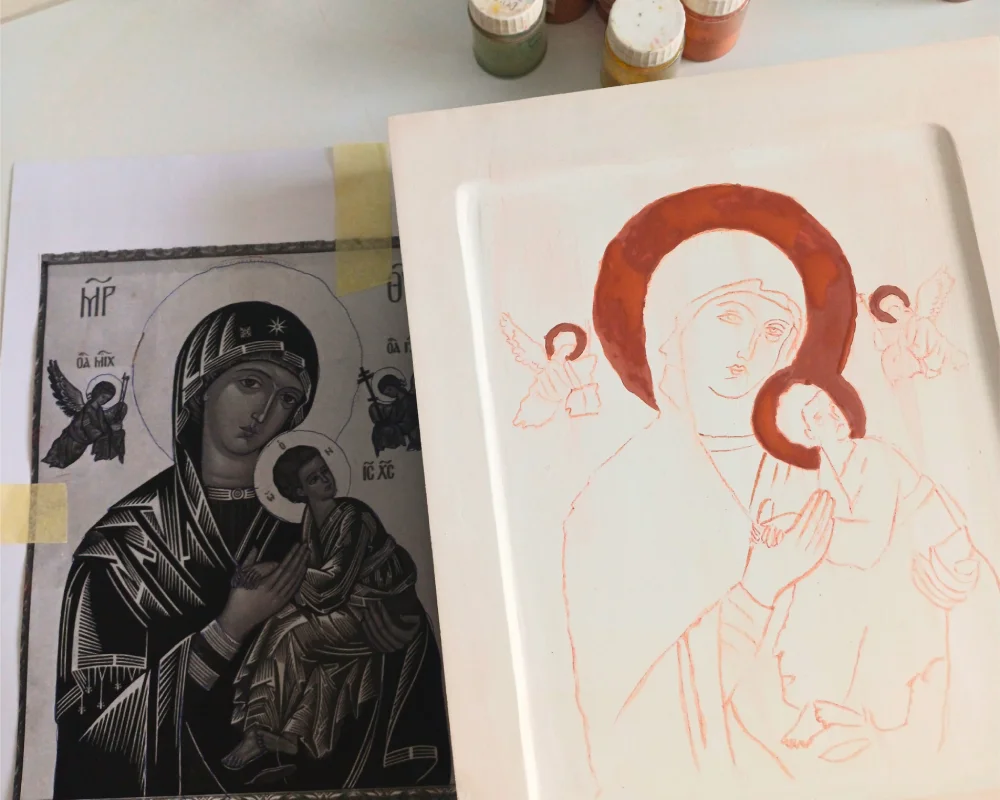
Our Lady of Perpetual Help Hand-Painted Icon: The Miracle-Working Byzantine Art for Your Home

In the sacred world of Christian iconography, few images carry as much theological depth and historical grandeur as the Our Lady of Perpetual Help Hand-painted Icon. For devout families, passionate collectors of catholic religious art, and believers across the United States, this ancient Byzantine image serves as a powerful spiritual bridge between earthly struggles and heavenly solace.
The Mysterious Origins and Sacred Journey of the Our Lady of Perpetual Help Hand-Painted Icon
The tradition of Eastern Christian iconography teaches us that a true icon is born from deep prayer, fasting, and strict adherence to artistic canons. Art historians and Byzantine scholars tracing the roots of this unique representation of the Blessed Virgin Mary and the Christ Child point to its Cretan origins. Historical accounts suggest that the original miraculous image was masterfully painted on walnut wood originating from the island of Crete, a material chosen for its noble durability.
Modern research and historical tradition attribute the authorship of this timeless masterpiece to a legendary hagiographer: Andreas Rizo de Candia. This renowned 15th-century master blended Western artistic refinement with the austere, solemn mysticism of Byzantine art. It was his skilled hand that gave the Virgin Mary her unique expression—one of profound sorrow, regal dignity, and endless maternal tenderness—which continues to inspire master iconographers to this day.
The Road to Rome and the Legacy of the Church of San Matteo
Before achieving global recognition, the sacred image endured a turbulent journey. For nearly three centuries (from 1499 to 1798), the focal point of its public veneration was the Church of San Matteo in Via Merulana in Rome. This sanctuary became a bustling center of prayer where thousands of pilgrims gathered to beg for heavenly intervention.
When the church was destroyed during the Napoleonic wars, the icon was hidden by dedicated monks to save it from destruction, disappearing from public sight for decades. The true renaissance of its global devotion occurred in the 19th century when it was rediscovered and entrusted to the Redemptorists (the Congregation of the Most Holy Redeemer). Pope Pius IX, deeply moved by the icon’s beauty, commanded the order with a prophetic mandate: “Make her known throughout the world.” The Redemptorists fulfilled this mission with absolute zeal. Today, the original miraculous icon rests in Rome at the Church of St. Alphonsus Liguori, near its original home on Via Merulana, drawing millions of pilgrims from every corner of the earth.
Deep Theological Symbolism: The Hodegetria and the Passion
To fully appreciate the spiritual value of an Our Lady of Perpetual Help hand-painted icon, one must decipher its complex symbolic language. In Eastern Christian art, this composition belongs to the revered class known as the Hodegetria (Greek for “She who shows the Way”). Mary does not draw attention to herself; her right hand, while gently cradling the hands of her Son, points directly to Jesus Christ as the Way, the Truth, and the Life. In Western Catholic traditions, this depiction is also widely known as Our Lady of Sorrows, due to its prophetic elements foreshadowing the salvific crucifixion at Calvary.
Royal Garments, Stella Maris, and Heavenly Halos
Every color applied to the wooden canvas carries precise theological significance. In this byzantine depiction, Mary wears garments of red and dark blue. The deep red of her tunic symbolizes royalty, virginity, and martyrdom—a testament to her status as the Queen of Heaven. Conversely, her dark blue mantle represents her human nature, signifying that she was a creature of earth chosen to clothe the Divine.
On her veil, directly above her forehead, shines a brilliant gold star. This is a visual reminder of her traditional title, Star of the Sea (Stella Maris)—the one who guides lost souls through the stormy seas of life into the safe harbor of salvation. At Iconoria Studio, we pay absolute attention to the theology of light: the Angels, the Mother of God, and Jesus are all adorned with radiant, shimmering golden halos, symbolizing their eternal glory and presence in the uncreated light of God. Furthermore, the original icon featured a solid gold background, representing the transcendent reality of Heaven.
The Archangels and the Prophetic Detail of the Loose Sandal
Flanking the central figures are two heavenly messengers shown in a smaller scale to emphasize the central importance of the Incarnation. These are Archangel Michael (on the left) and Archangel Gabriel (on the right). In their hands, covered with veils out of liturgical reverence, they hold the instruments of Christ’s Passion:
- Archangel Michael holds the lance, the sponge soaked in vinegar, and the reed;
- Archangel Gabriel holds the cross of salvation and the sacred nails.
The sight of these instruments of torture strikes a natural, human fear into the heart of the Divine Child. Jesus is depicted clutching His Mother’s hand with both of His, causing a loose sandal to slip from His foot as He recoils in fright. This moving, deeply human detail highlights the dual nature of Christ: He is fully Divine (aware of His ultimate sacrifice), yet fully human, experiencing genuine human fear before His suffering.
Global Devotion, Miracles, and Liturgical Traditions
For centuries, this icon has been celebrated for countless miracles, physical healings, and extraordinary answers to prayer. It is difficult to find another Marian image that enjoys such universal and fervent devotion across all continents.
A Universal Witness of Faith
Devotion to Our Lady of Perpetual Help Hand-painted Icon developed dramatically across vastly different cultures. She is intensely venerated in Haiti, Singapore, the Philippines, and the United States. In Manila, Philippines, the National Shrine of Baclaran gathers hundreds of thousands of believers every single week, making it one of the largest centers of constant intercessory prayer in the world.
History also records powerful, collective acts of faith where entire nations threw themselves at her feet. Desperate prayers were raised to this icon during catastrophic earthquakes in Haiti, as well as in other nations seeking deliverance from devastating smallpox epidemics. In moments of crisis, the faithful have always repeated the historic, hopeful Latin phrases:
Deiparæ Mater et Virginis Succursu Perpetui (Latin for “Virginal Mother who bore God, May always Assist us”) and Nostra Mater de Perpetuo Succursu.
In the Catholic liturgical calendar, the official feast day of this miraculous icon is celebrated on June 27th. The most famous tradition tied to this image is the Weekly Perpetual Novena. This devotion remains incredibly vibrant in thousands of parishes worldwide, where every Wednesday, special prayers are offered before her image, presenting the petitions of those seeking comfort in seemingly hopeless situations.
An Elite Gift of Eternal Spiritual Value
A hand-painted icon of the Blessed Virgin Mary makes an exquisite and deeply meaningful wedding gift for newlyweds, bringing divine protection into their new home. It is also an unparalleled choice for wedding anniversaries, baptisms, confirmations, and major family milestones.
While this specific Our Lady of Perpetual Help masterpiece will soon be available for purchase at Iconoria Studio, you can already prepare your sacred space with other traditional imagery.
To complete a family altar, discover the majestic collection of Jesus Icons alongside deeply moving Passion Icons including the Crucifixion and Epitafios that beautifully capture the ultimate mystery of Faith.
FAQ:
Q: When is the feast day of Our Lady of Perpetual Help, and what are its main devotions?
A: The official liturgical feast day is celebrated on June 27th. The central and most popular devotion is the Weekly Perpetual Novena, which is traditionally prayed in Catholic parishes every Wednesday to ask for maternal protection and intercession.
Q: When was the original Our Lady of Perpetual Help icon created?
A: Historical and artistic analysis dates the creation of the original miraculous icon to the late Byzantine period, specifically between 1325 and 1480. This era was the golden age of the Cretan School of iconography, led by masters like Andreas Rizo de Candia, who combined strict Eastern theological canons with subtle Western European artistic elegance.
Q: Where can I buy this miraculous icon with free worldwide shipping?
A: This hand-painted icon is available for purchase at the online store Iconoria. The studio provides fast, secure, and 100% free shipping to the US and worldwide, ensuring the sacred image delivers safely to any destination.
Q: What does the “Hodegetria” style mean for this icon?
A: Hodegetria means “She who shows the Way” in Greek. In this style, the Virgin Mary does not draw attention to herself; instead, her hand points directly to Jesus Christ, guiding the viewer to Him as the source of salvation.