
Crafted in Europe, Shipped Worldwide
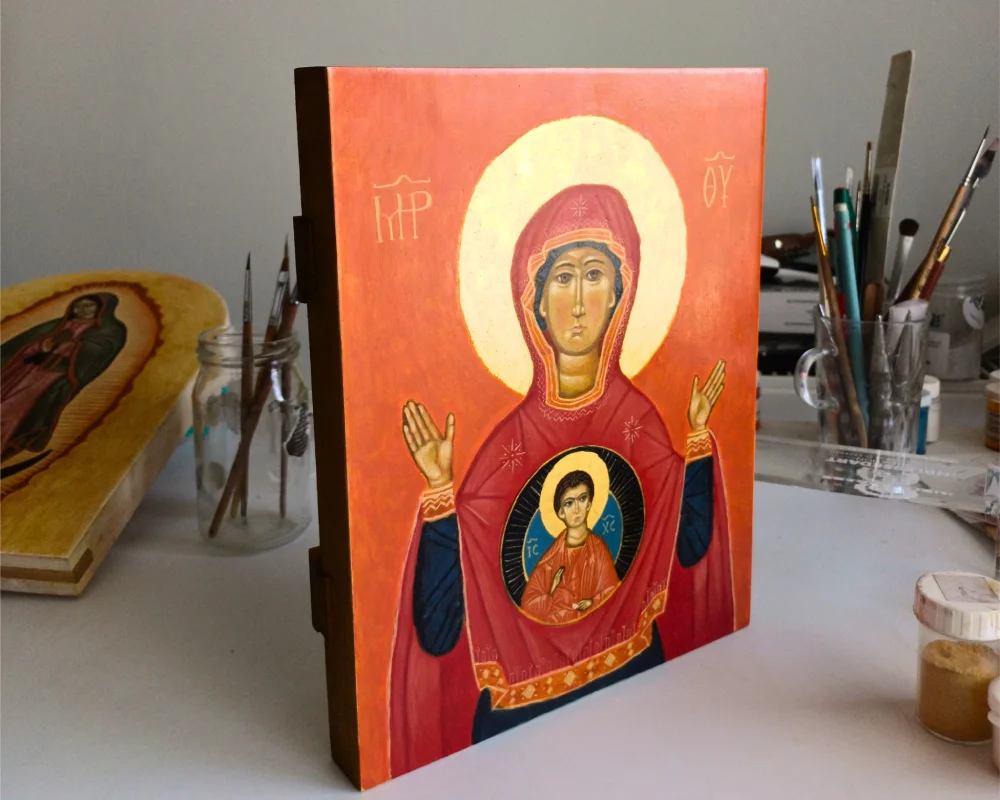
Handmade Mother of God Orant Icon: The Eternal Gesture of Prayer

In the realm of sacred iconography, few images command as much reverence and theological depth as a handmade Mother of God Orant Icon. Known in the East as the Panagia or the Platytera, this depiction is not merely a religious painting; it is a liturgical window into the infinite. For the modern believer seeking to enrich their prayer life, a handmade Mother of God Orant icon serves as a bridge between the earthly and the divine, meticulously crafted to preserve a tradition that dates back nearly two millennia.
The Theology of the Orant Pose: Standing in Eternal Prayer
The term Orant (from the Latin orans, meaning “one who prays”) describes a specific iconographic posture: the Virgin Mary is shown with her arms extended and hands lifted toward the heavens. This orant pose is a gesture of profound intercession, representing the Church’s soul in constant dialogue with God.
When we look at the Theotokos (the God-Bearer) in this posture, we see the ultimate model of Christian prayer. She is the bridge between humanity and the Creator. This specific image is often called the Mother of God of the Sign, referencing the prophecy of Isaiah: “Therefore the Lord himself will give you a sign: The virgin will conceive and give birth to a son.”
Understanding the “Platytera” and the Mystery of the Womb
A central feature of this icon is the depiction of the Christ Child (Emmanuel) within a circular nimbus or medallion on Mary’s breast. This signifies the moment of the Annunciation and the Incarnation. Even though Jesus is depicted within her womb, He is shown in His divine majesty—often holding a scroll and raising His hand in a blessing.
Interestingly, although He is the “Child,” His facial features often reflect the wisdom of an adult, emphasizing that He is the pre-eternal Word of God. This composition earned the icon the name Platytera (Greek for “Wider than the Heavens”), because Mary, by containing the uncontainable God, became “wider” than the universe itself.
Historical Significance: From Ancient Catacombs to the Walls of Novgorod
The roots of the orthodox Orant icon stretch back to the catacombs of Rome, but its historical power was solidified in the medieval era. One of the most famous accounts of this icon’s power dates back to 1170 in Novgorod. According to tradition, when the city was under siege, the citizens brought the Icon of the Sign to the city walls. When an arrow struck the image, the Virgin turned her face toward the city and shed tears, blinding the invaders and saving Novgorod from certain destruction.
This protective quality makes the Orant a favored choice for those seeking a “Guardian of the Home.” In the United States, a stunning modern connection to this tradition can be found in Chicago at St. Stanislaus Kostka Church. As a central hub for the Polish diaspora, this church houses the iconic Monstrance of Our Lady of the Sign in the Sanctuary of the Divine Mercy, where perpetual adoration takes place.
Crafting the Divine: The Art of Egg Tempera and 24k Gold Leaf
When you choose a piece from the Iconoria studio, you are not buying a mass-produced print. You are commissioning a unique piece of hand-painted icons history. Each icon is a labor of love, following the strict canons of traditional iconography.
The Alchemy of the Master’s Workshop
I believe that the materials used in sacred art should be as pure as the intent behind the prayer. My process involves:
- Solid Wood Panels: I use seasoned wood with oak “sponki” (cross-slats) to prevent warping over time.
- Egg Tempera: This ancient medium combines natural pigments with egg yolk and wine. Unlike modern acrylics, egg tempera gains a gemstone-like hardness and depth over the decades.
- 24k Gold Leaf: I apply genuine 24k gold leaf to the nimbi (halos) and sometimes on backgrounds. This is not for mere decoration; the gold represents the “Uncreated Light” of God that surrounds the saints.
Experience the Craft: View my process and dedication to quality here: hand-painted icons – Workshop Gallery.
Why Every Christian Home Needs a Handmade Mother of God Orant Icon
Whether you are looking to start a “Beautiful Corner” (Icon Corner) or seeking a meaningful gift, the Mother of God Orant is a versatile and powerful choice.
Benefits of Hand-Painted Icons:
- A Heritage Piece: Because I use traditional egg tempera, these icons will last for generations, becoming family heirlooms.
- Home Altar Centrality: The Orant pose creates an atmosphere of peace and constant intercession in your living space.
- Perfect for All Occasions: A high-quality icon is a perfect gift for weddings, baptisms, or housewarmings.
- Free Shipping: I offer free shipping on all handmade icons to ensure your sacred art arrives safely and without extra cost.
If you are looking for a companion piece for your icon corner, I highly recommend browsing a category of Jesus Icons, which are painted with the same level of devotion and gold-leaf detail.
How to Place the Mother of God of the Sign in Your Home
Traditionally, icons should be placed on an eastern wall or in a dedicated prayer space. The Mother of God Orant is particularly suited for:
- The Bedroom: To provide a sense of protection and a final point of focus for evening prayers.
- The Living Room: As a witness of faith to all who enter the home.
- The Domestic Chapel: Serving as the “Platytera” focal point.
For more diverse options of the Virgin Mary, including the Hodegetria or Eleusa styles, visit my full collection of Mary Icons.
Bring the Light of the Theotokos Home
Don’t settle for a paper reproduction when you can own a piece of living tradition. Hand-painted Mother of God Orant icon is window to heaven, painted with prayer and finished with the brilliance of 24k gold.
Order your custom Hand-Painted Mother of God Orant Icon today!
Q: What is the difference between “Orant” and “The Sign”?
The terms are often used interchangeably. “Orant” refers to the posture (arms raised), while “The Sign” refers to the theological meaning of the icon as a fulfillment of the prophecy in Isaiah 7:14.
Q: Why does the Christ Child look like a small adult on the icon?
In orthodox iconography, Christ is shown with adult features to signify that He is the Logos—the Eternal Wisdom of God—who existed before all ages, even while appearing as a human child.
Q: Is the gold leaf on the halos real?
Yes, I use authentic 24k gold leaf. This provides a unique, warm reflection of light that cannot be replicated by metallic paints or chemical imitations.
Q: How long does it take to paint a custom icon?
Due to the many layers of gesso, gold, and tempera, a custom icon usually takes 4 to 8 weeks to complete. This ensures the materials are properly cured and the artistic details are perfect.
Q: Is the shipping really free to the USA?
A: Yes, I offer free shipping on all my icons. I use professional-grade packaging to ensure the wooden panel and gold leaf are protected during transit.