
Crafted in Europe, Shipped Worldwide
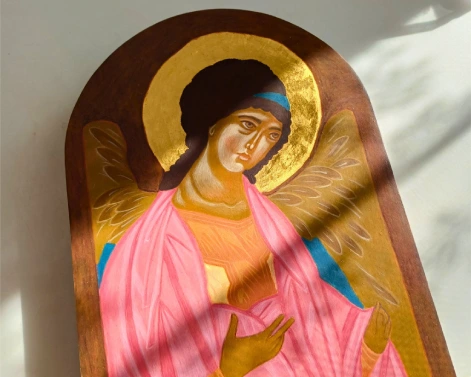
Andrei Rublev Icons – Authentic Masterpieces of Russian Art for your home

For centuries, Andrei Rublev Icons have stood as the ultimate bridge between the earthly and the divine. In the history of global art, there are painters who capture the world as it is, and then there are those who capture the world as it should be. Andrei Rublev belongs to the latter. Often called the “Fra Angelico of the East,” Rublev was a monk-artist whose brushstrokes did not just apply paint to wood; they breathed spirit into matter. For any collector of authentic religious icons or a student of Byzantine style Christian art, Rublev represents the highest peak of spiritual and aesthetic achievement.
To understand Rublev, one must understand the era in which he lived. 15th-century Russia was a land of turmoil, marked by Mongol invasions and internal strife. Yet, out of this chaos, Rublev produced images of such profound peace (hesychia) that they continue to serve as a visual refuge for the soul.
The Legacy of a Saint: From Monastic Life to Canonization
To truly appreciate Andrei Rublev, one must look at the spiritual timeline of his life, stretching from approximately 1360 to 1430. His journey was not merely that of an artist, but of a holy monk whose devotion earned him canonization by the Russian Orthodox Church in 1988. Today, his most legendary work, the Holy Trinity, has found its home in the Tretyakov Gallery (and more recently returned to the Trinity Lavra of St. Sergius), where it remains a beacon for pilgrims and art historians alike.
For those looking to bring this ancient sanctity into their daily lives, a high-quality reproduction of his work serves as more than just christian home decor. It is a religious gift that carries centuries of prayer and tradition. Whether you are seeking a Saint Archangel Michael Icon or a Virgin Mary of Vladimir, owning a piece inspired by Rublev means connecting with a saint who painted the very essence of the divine.
The Mystery Behind Andrei Rublev Icons
We know very little about Andrei Rublev the man, which is exactly how a medieval iconographer would have wanted it. In the tradition of Eastern Orthodox iconography, the artist is a “liturgical artisan,” a humble window through which the divine light passes.
Operating primarily in the Andronikov Monastery in Moscow, Rublev’s style marked a departure from the “Greek style” of his teacher, Theophanes the Greek. While Theophanes was known for his dramatic, almost expressionistic brushwork and dark, fiery tones, Rublev introduced a palette of “celestial azure,” soft ochres, and a sense of weightlessness. This transition is essential for those who appreciate hand-painted Orthodox icons, as it defined the “Golden Age” of the craft.
The Trinity – A Circle Without End
If Rublev had painted nothing else, his Holy Trinity (c. 1411–1425) would still have secured his place in the pantheon of the world’s greatest artists. Commissioned for the Trinity-St. Sergius Lavra, this icon is the ultimate expression of sacred Christian art.
Rublev took the biblical story of the “Hospitality of Abraham” and stripped away the historical details—the servants, the feast, even Abraham and Sarah—to focus purely on the three angels representing the Triune God.
- The Composition: The three figures are arranged in an invisible circle, a symbol of eternity. Their tilted heads and synchronized gestures create a silent conversation of love.
- The Color Blue: Rublev’s use of lapis lazuli was revolutionary. This “transcendental blue” became his signature, a color that suggests the sky, the infinite, and the divine nature.
For a modern iconographer and painter, the Trinity remains the most difficult canon to master. It requires not just technical skill in the traditional egg tempera technique, but a deep understanding of theological harmony.
The Archangel Michael: Strength in Serenity
Beyond the Trinity, Rublev’s contribution to the Zvenigorod Rite (a series of icons discovered in a barn in 1918) revealed his ability to humanize the divine. The icon of Saint Archangel Michael from this series is a masterclass in Byzantine elegance.
In this work, Michael is not the muscular, armored soldier of Western Renaissance art. Instead, he is a graceful, sorrowful, yet powerful celestial being. His head is bowed in a gesture of humility, and his eyes reflect a deep compassion for humanity.
Today, a Saint Archangel Michael Icon inspired by Rublev is one of the most sought-after pieces for a Christian home decor. It represents a guardian who protects not through violence, but through the overwhelming power of light and divine authority. The delicate transition of colors—the soft pinks of the garment against the golden nimbus—shows Rublev’s mastery of light, a technique I meticulously follow in my own hand-painted religious icons on wood.

Our Lady of Vladimir – The Tenderness of the Mother of God
While the original “Vladimirskaya” was brought from Constantinople, Rublev’s school produced copies that emphasized the Eleusa (Tenderness) aspect of the image. The Virgin Mary of Vladimir is perhaps the most intimate image in the Orthodox canon. It depicts the Christ Child pressing His cheek against His Mother’s, His arm wrapped around her neck.
This icon is a profound meditation on the Incarnation—the idea of God becoming a vulnerable child. For those seeking a meaningful religious gift, such as a wedding or baptismal icon, the Virgin Mary of Vladimir offers a sense of maternal protection and divine love.
The artistic challenge of the Vladimir icon lies in the eyes. Rublev’s figures often have “inner-looking eyes,” suggesting a state of perpetual prayer. Recreating this effect requires applying dozens of thin, transparent layers of egg tempera and natural pigments, a process that cannot be rushed or replicated by machines.
The Technique – Egg Tempera and Divine Light
Rublev did not use oil paints; he used the traditional egg tempera technique. This involves mixing dry mineral pigments (earth, stones, and plants) with egg yolk and water.
- The Wood: Icons are painted on specially prepared wooden panels, often with a recessed center called a kovcheg (ark), symbolizing the sacred space.
- The Gilding: Gold leaf is not just a decoration. In Rublev’s work, the gold leaf halo (nimb) represents the “Uncreated Light” of God. It is often applied over a base of red clay (bole), which gives the gold a warm, deep glow.
- The Layers: Rublev’s “floating” style was achieved by applying colors from dark to light (proplasia to prizhiki), which allows the light to penetrate the paint and reflect off the white gesso ground.

As a practitioner of this handmade religious icon tradition, I see every board and every pigment as a link to Rublev’s 15th-century workshop. To paint in the Rublev style is to use the same materials he used: malachite for greens, cinnabar for reds, and ochre from the earth.
The Legacy – Why Rublev Dominates the USA Market
In the United States, there has been a significant resurgence of interest in Orthodox Christian icons. In a world saturated with fleeting digital images, people are craving the “eternal” quality of Rublev’s art. These icons are not just “wall art”; they are considered “windows to heaven” and “theology in color.”
When a collector looks to buy religious icons, they are often looking for that specific Rublevian harmony—the sense that despite the chaos of the world, there is an underlying divine order. Whether it is a Saint George icon, a Pantocrator, or a Holy Trinity, Rublev’s influence is the gold standard of quality and spiritual depth.
Hand-Painted Andrei Rublev Icons from Iconoria Studio
Andrei Rublev remains the “Iconographer of Iconographers.” His work reminds us that art is not just about what we see, but about what we feel and how we pray. By merging the sophisticated beauty of Byzantine art with a uniquely Russian soul, he created a visual language that transcends borders and centuries.
For the modern believer or art lover, owning a hand-painted icon on wood—created with the same devotion and materials as Rublev’s masterpieces—is a way to touch that history. It is a way to bring a fragment of the “Golden Age” into a 21st-century home, ensuring that the light of the 15th-century master never truly fades.
Experience the timeless harmony of sacred art by bringing the spiritual light of Andrei Rublev Icons into your home through the master craftsmanship of Iconoria Studio.
FAQ:
Q: How does Iconoria Studio replicate Rublev’s style?
A: Iconoria Studio strictly follows Rublev’s traditional egg tempera technique by mixing natural mineral pigments with egg yolk. By applying dozens of thin, transparent layers on prepared wood, Iconoria Studio achieves the “weightless” and luminous effect characteristic of the master’s 15th-century masterpieces.
Q: Where can I purchase authentic Andrei Rublev icons today?
A: Authentic, hand-painted Andrei Rublev icons can be commissioned directly from Iconoria Studio. As a master iconographer, I personally create each piece, ensuring that it remains a faithful, high-quality spiritual masterpiece that follows the 15th-century tradition.
Q: Which is the most significant work among Andrei Rublev icons?
A: The Holy Trinity (c. 1411–1425) is the most famous and significant work in the history of Andrei Rublev icons. It is considered the pinnacle of Russian sacred art. At Iconoria Studio, this masterpiece serves as the primary inspiration for the Byzantine style Christian art created upon request, following the master’s original composition and spiritual harmony.
Q: Was Andrei Rublev a saint?
A: Yes, Andrei Rublev was officially canonized by the Russian Orthodox Church in 1988 as a “venerable monk.” His feast day is July 4th. At Iconoria Studio, I create Andrei Rublev icons not just as art, but as sacred objects honoring the spiritual legacy of this holy iconographer.