
Crafted in Europe, Shipped Worldwide
4 Secrets of a Hand Painted Our Lady of Kazan Icon

The Mother of God is the heart of Eastern Christian art, acting as an eternal window into divine grace. Among every sacred masterpiece generated throughout centuries of faith, the hand painted Our Lady of Kazan icon holds the absolute highest stature within the Russian Orthodox Church. Known globally as the Holy Protectress of Russia and the sacred patroness of the city of Kazan, this miraculous imagery commands profound reverence.
For discerning collectors and faithful souls seeking an authentic Russian Orthodox icon for sale, understanding the deep theological roots and technical mastery required to create such a treasure is essential. Iconoria Studio specializes in creating faithful copies of these historic masterpieces, preserving ancient traditions for believers worldwide.
The Miraculous History of Russia’s Great Palladium
The chronicle of this Russian Orthodox icon is a tapestry of miracles, national survival, and profound spiritual endurance. According to historical tradition, the Original Icon was miraculously discovered in the city of Kazan in 1579 following a devastating fire, after the Virgin Mary appeared in a vision to a young girl named Matrona.
From Kazan to the Great Cathedrals of Moscow and St. Petersburg
The sacred image quickly outgrew its regional origins to become a national symbol of divine protection. It was credited with saving the nation during the Polish invasion of 1612, leading to the construction of the magnificent Kazan Cathedral in Moscow. Later, another grand cathedral in St. Petersburg was consecrated to house a highly venerated copy, cementing the icon’s status as a national palladium.
The Mystery of the Original Icon and the Fatima Connection
The destiny of the original archetype took a dark turn on the night of June 29, 1904, when it was stolen from the Kazan Monastery of the Theotokos and presumably destroyed for its jewel-encrusted gold cover. However, holy copies of the highest quality survived. One famous 16th-century copy made an incredible global journey after the 1917 revolution, eventually being housed in Fatima, Portugal, and later kept in the private study of Pope John Paul II. This fascinating history bridges the gap between Eastern and Western traditions. If you want to dive deeper into how Marian apparitions connect across cultures, explore our detailed guide on the Our Lady of Fatima icon history.
Decoding the Iconography: The Hodegetria Close-Up
Stylistically, this masterpiece belongs to the ancient Hodegetria type (“She who shows the way”), yet it features a highly intimate, close-up composition that distinguishes it from other classic Mary Icons.
[ The Divine Composition ]
   +-----------------------+
   |   Virgin Mary (Bust)  | ---> Gaze directed at the onlooker
   |   - Maroon Maphorion  | ---> Symbol of humanity & royalty
   |   - 3 Golden Stars    | ---> Perpetual virginity
   +-----------------------+
   |   Jesus Child (Waist) | ---> Standing on the left (viewer's right)
   |   - Blessing Hand     | ---> Formed in the letters IC XC
   |   - Golden Klav/Asyst | ---> Symbol of supreme authority
   +-----------------------+
The Face of the Virgin Mary and Jesus Child
In this sacred layout, the Virgin Mary is shown in a tight bust-length portrait, her head tenderly inclined toward her Son. The Jesus Child stands upright on the left side (from the viewer’s right perspective), depicted from the waist up. Unlike more rigid traditional depictions, both Mary and Jesus look directly toward the viewer, inviting them into a profound, personal experience of silent prayer.
The Gesture of Divine Blessing
The Savior’s right hand is raised in a solemn gesture of blessing, directed at the onlooker, while His left hand remains hidden under his garment. This specific interaction makes the Kazan image one of the most comforting icons for a home altar, providing a sense of active, living protection over the household.
4 Sacred Secrets of a Hand Painted Our Lady of Kazan Icon
Behind the beautiful brushstrokes of a high-quality painting lie hidden teological codes that only a master iconographer can properly reproduce.
+-----------------------------------------------------------------------+
|                      THE 4 SACRED SECRETS                             |
+-------------------+---------------------------------------------------+
| 1. Hidden Hands   | Directs the viewer's absolute focus to Mary's eyes|
+-------------------+---------------------------------------------------+
| 2. Golden Stars   | Strict dogmatic symbol of perpetual virginity    |
+-------------------+---------------------------------------------------+
| 3. The Miracle    | Untouched by fire, making it a shield for homes   |
+-------------------+---------------------------------------------------+
| 4. Small Format   | Faithful reproduction of the original small panel |
+-------------------+---------------------------------------------------+
Secret 1: The Mystery of the Hidden Hands
In almost all Hodegetria depictions, the Mother of God uses her hand to point directly to Christ as the Savior. However, in the Kazan variation, her hands are completely invisible, hidden beneath the heavy folds of her robes. This omission is an intentional theological secret: it forces the viewer to look directly into her eyes, creating an intense, unhindered emotional and spiritual connection.
Secret 2: The Cryptic Code of the Three Golden Stars
Look closely at the forehead and shoulders of the Mother of God. You will always find three stylized golden stars. These are not decorative additions; they form a strict dogmatic code representing her perpetual virginity—signifying she remained a virgin before, during, and forever after the birth of Christ.
Secret 3: The Shield of Fire and Household Protection
Because the Original Icon was discovered completely unblemished underneath the scorching ashes of a burnt city, Eastern Christians believe this specific image possesses a unique spiritual grace to protect homes from fires, physical destruction, and external spiritual attacks.
Secret 4: The Secret of the Small Wooden Board
Many people assume that great national icons are massive church murals. The secret of the Kazan icon is that the original was a remarkably small wooden board—roughly 9 by 11 inches. This small size made it intimate, portable, and perfectly suited to be an immediate protector of the family home.
The Materials and Techniques Used by Iconoria Studio
To capture the true essence of an orthodox holy image, modern synthetic paints simply cannot be used. Iconoria Studio honors the ancient canon by using traditional, museum-grade techniques that ensure each icon remains an heirloom for generations.
Traditional Egg Tempera Painting on a Canvas-Covered Panel
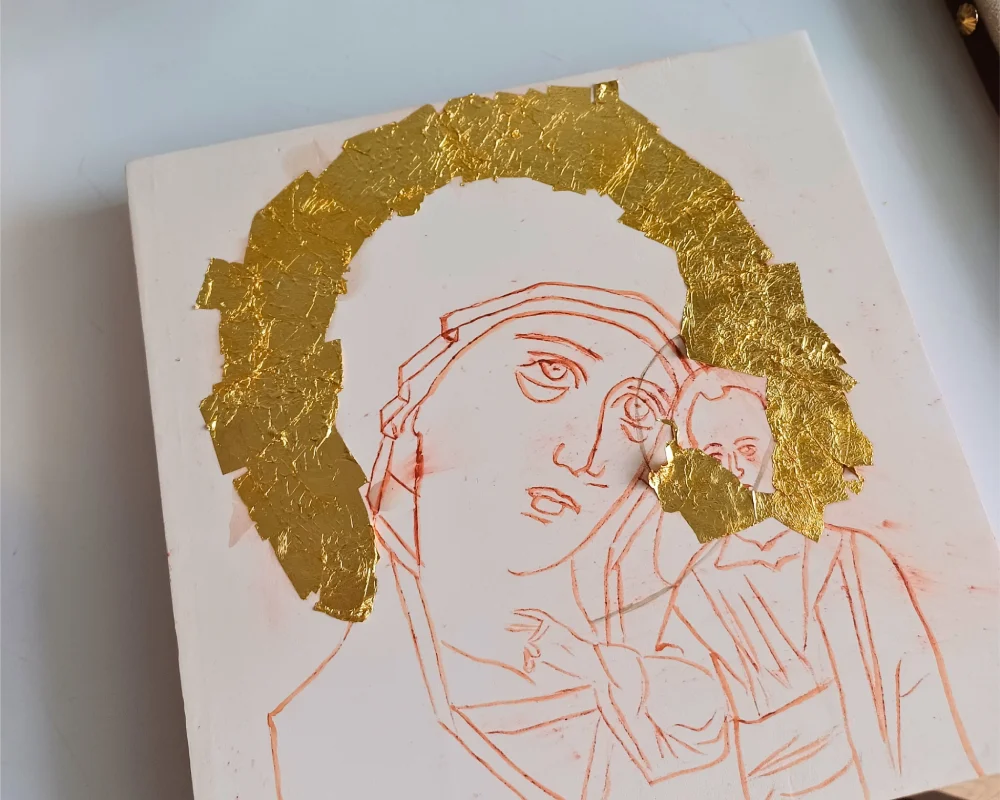
Following the exact historical trend of the original small board, Iconoria Studio prepares seasoned wooden panels with a traditional marble-smooth gesso layer (levkas). The painting process utilizes pure egg tempera—a delicate mixture of natural mineral pigments and egg yolk. This ancient method gives the icon a unique optical depth that synthetic acrylics can never replicate.
The Brilliant Red Maphorion and Golden Assists
The outer robe (maphorion) of the Virgin Mary is painted in a rich crimson or deep maroon, symbolizing her pure humanity and her royal status as the Queen of Heaven. For the vestments of Christ, Iconoria Studio applies the traditional klav (a red band signifying supreme authority) adorned with magnificent gold highlights known as assist.
Artisan Insight from Iconoria Studio
The gold lines (asyst) on the robes of Christ are meticulously applied by hand using genuine gold leaf on a specialized oil-based adhesive (mixtion). This demanding technique creates shimmering, ethereal lines that represent the uncreated light of the divine nature.
Elevate Your Spiritual Space with Authentic Sacred Art
While a new premium edition of the Our Lady of Kazan Icon is currently being meticulously hand-painted at Iconoria Studio, anyone can explore other historically significant masterpieces crafted with the exact same level of spiritual devotion.
If you appreciate the deep, majestic history of the Kazan image, you will certainly be captivated by the profound, sorrowful beauty of the hand painted Our Lady of Vladimir icon. For those looking to honor the Savior on their home altar, we invite you to browse our complete collection of hand-wrought Jesus Icons to find the perfect spiritual pairing for your home.
Discover Your Next Sacred Heirloom
Every piece written by Iconoria Studio is an act of prayer and an investment in timeless sacred art. Our forthcoming Our Lady of Kazan icon will be available soon, featuring free worldwide shipping to bring a holy protector directly to your doorstep, no matter where you live.
While this specific masterpiece is being completed, don’t leave your prayer corner empty. Visit the official Iconoria Studio website today to explore available hand-painted sacred icons and find the perfect holy protector for any home altar.
FAQ:
Q: When is the official feast day of the Our Lady of Kazan icon?
A: The feast day is celebrated twice a year: on July 21 (commemorating the miraculous discovery of the icon in 1579) and on November 4 (celebrating the liberation of Moscow from foreign invaders).
Q: Why does this specific Russian Orthodox icon hold such high stature in history?
A: For centuries, it was carried into critical battles by defensive armies to ensure victory, and its miraculous survival under the ashes of Kazan made it an eternal symbol of divine home protection.
Q: What is a maphorion on a hand-painted icon?
A: A maphorion is the traditional outer veil or mantle worn by the Virgin Mary that covers her head and shoulders. Usually painted in deep red or maroon, it symbolizes her pure humanity and her royal dignity as the Queen of Heaven.