
Crafted in Europe, Shipped Worldwide
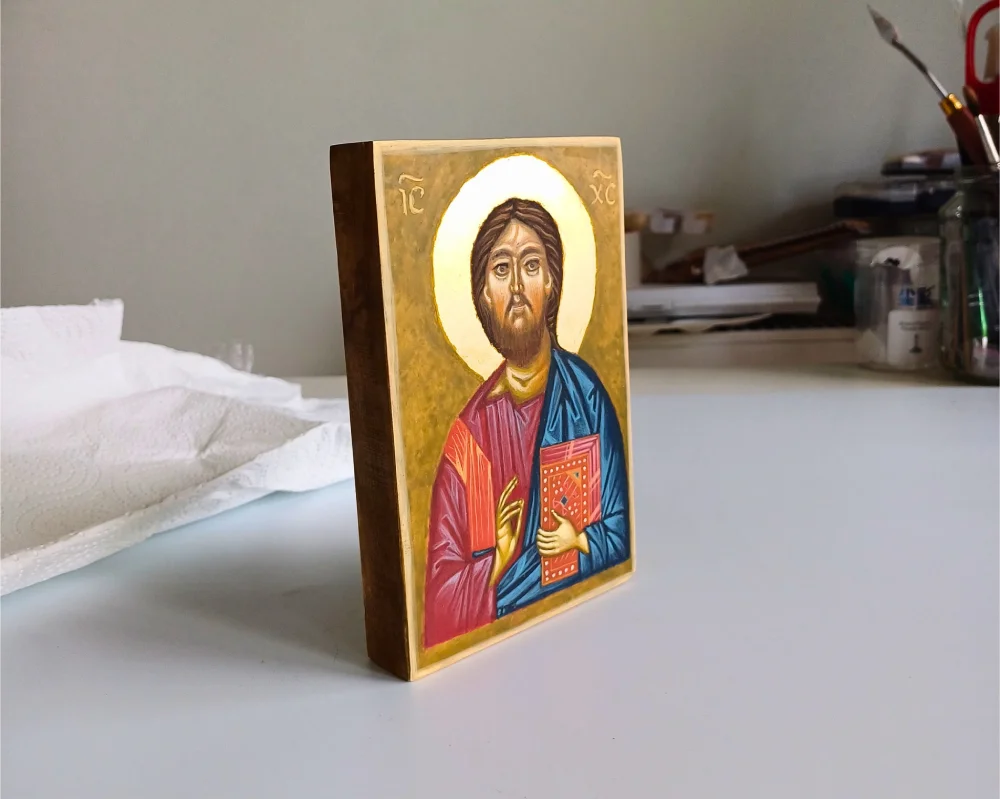
The Divine Presence: Why a Hand-Painted Christ Pantocrator Icon is the Heart of Every Christian Home

In the quiet corners of a home, where prayer meets the soul, few images carry the weight and majesty of the hand-painted Christ Pantocrator icon. For centuries, this depiction of Christ Almighty has served as the “window to heaven,” a theological statement captured in wood, pigment, and gold.
As an iconographer dedicated to the ancient techniques of the masters, I hand-paint each icon on seasoned linden wood using the traditional egg tempera method. When you hold one of these icons, you aren’t just holding art; you are holding a legacy of faith that dates back to the earliest days of Christian iconography.
What Does Christ Pantocrator Signify?
The term “Pantocrator” comes from the Greek words pan (all) and kratos (strength/power). In the Eastern Orthodox and Byzantine tradition, Christ Pantocrator signifies Christ in Glory during His second coming, often seated on His throne.
While the image is ubiquitous in cathedrals, having a hand-painted version in your personal prayer space transforms the atmosphere of a room. It serves as a constant reminder of Christ’s dual nature: His divine authority as the Judge of the world and His infinite mercy as the Teacher.
While the Pantocrator displays His divine authority, other depictions focus on His intimate relationship with the saints, such as the unique Christ and Abbot Mena icon, which beautifully symbolizes the friendship between God and man.
The Deep Symbolism of the Hand-painted Christ Pantocrator Icon
Every stroke of the brush in a traditional icon is intentional. In the Christ Pantocrator image, the Savior is typically depicted holding the New Testament in His left hand, while His right hand is raised in a gesture of blessing or teaching.
The Christogram and the Blessing Hand
If you look closely at the fingers of the right hand, they are posed to represent the letters IC, X, and C, forming the Christogram IC XC (the abbreviation for “Jesus Christ” in Greek). This is not a random gesture; it is a visual signature of the Creator.
The Symbolism of the Gospel: Open vs. Closed Book
In the traditional Byzantine Savior icon, the Gospel held by Christ is one of the most significant elements. There is a profound theological distinction between these two depictions:
- The Open Book: This version of the Lord Almighty icon often displays specific Greek or Cyrillic verses. Usually, these are words of comfort (“Come to me, all you who are weary”) or divine instruction. It emphasizes Christ’s role as the Teacher and the Word of God made flesh.
- The Closed Book: In many historical Pantocrator images, the book remains closed. This symbolizes the hidden mysteries of God or the “Book of Life” mentioned in the Book of Revelation, which only the Lamb of God is worthy to open. It points to the Second Coming and Christ as the final Judge.
While early Middle Ages iconography often placed the Ruler of All in a mandorla (an almond-shaped aura) or surrounded Him by the Four Evangelists (the Tetramorph), modern preference often focuses on the half-length portrait. This brings the viewer face-to-face with the piercing, yet compassionate gaze of the Lord, making the Christ the Teacher icon an intimate window for personal prayer.
The Halo and Gold Leaf in Hand-Painted Christ Pantocrator Icons
In my studio, I utilize authentic gold leaf to create the Halo (nimbus). The gold represents the Uncreated Light of God. Because I use traditional water gilding or gilding on mixtion size on linden wood, the halo reflects light differently at every hour of the day, symbolizing that Christ’s presence is ever-changing yet eternal.
Explore the Collection: If you are looking for a centerpiece for your home altar, view my Hand-Painted Jesus Icons category or browse my full Portfolio of Sacred Iconography.
Historical Roots: From Sinai to the Modern Home
The history of this image is as old as the Church itself. One cannot discuss this subject without mentioning the famous Christ Pantocrator at St. Catherine’s Monastery in the Sinai, dating back to the 6th century. It is the oldest known encaustic icon of its kind and remains the blueprint for all modern iconography.
Learn more about the historic Sinai Pantocrator at St. Catherine’s Monastery.
Christ in Majesty vs. Christ on Sinai
While the Christ in Majesty (often found in Western Romanesque art) emphasizes the apocalyptic throne and the mandorla, the Christ on Sinai emphasizes the “humanity” and the asymmetrical eyes of Christ—one side representing mercy, the other representing judgment. My work seeks to balance these elements, providing a bridge between the historical Eastern Orthodox tradition and modern American homes.
Why Choose a Hand-Painted Icon on Linden Wood?
In an age of mass-produced prints, a hand-painted icon stands apart. Here is why the materials matter:
- Linden Wood: It is the traditional choice for iconographers because of its stability and fine grain, ensuring the icon lasts for generations.
- Egg Tempera: Using natural pigments mixed with egg yolk creates a depth of color and luminosity that synthetic paints cannot replicate.
- Sacramental Art: A hand-painted icon is created in a state of prayer. It is “written” rather than just “drawn.”
Creating a Sacred Space in Your Home
Why does every Christian home need an icon of Jesus? It provides a focal point for the “Domestic Church.” Whether placed in a “Beautiful Corner” (Icon Corner) or on a mantel, it invites silence and reflection.
Read More: Why Every Christian Home Needs a Jesus Icon
Bring the beauty of ancient tradition into your home today.
Shop the Christ Pantocrator Icon or contact me to commission a unique, hand-painted masterpiece for your family.
Q: What does “Pantocrator” actually mean?
A: It is a Greek term meaning “Ruler of All” or “Almighty.” It depicts Christ as the sovereign Lord of the universe, a theme often seen in the central domes of Byzantine churches and famous Christ Pantocrator frescoes.
Q: Why is egg tempera used in iconography?
A: Egg tempera is one of the most durable mediums in history. It allows for thin, transparent layers (glazes) that build up the “light” in the face of the saint, creating the characteristic “inner glow” of traditional icons.
Q: What is the difference between a printed icon and a hand-painted one?
A: A hand-painted icon uses organic materials like egg tempera and gold leaf. Unlike prints, these icons have texture, reflect light naturally, and are considered liturgical items created through prayer and fasting by the iconographer.
Q: Do you offer international shipping from Poland?
A: Yes, I offer free worldwide shipping on all my hand-painted icons. Whether you are located in the United States, Canada, or Europe, your icon will be shipped directly from my studio in Poland at no extra cost to you.